
|
|
|
|
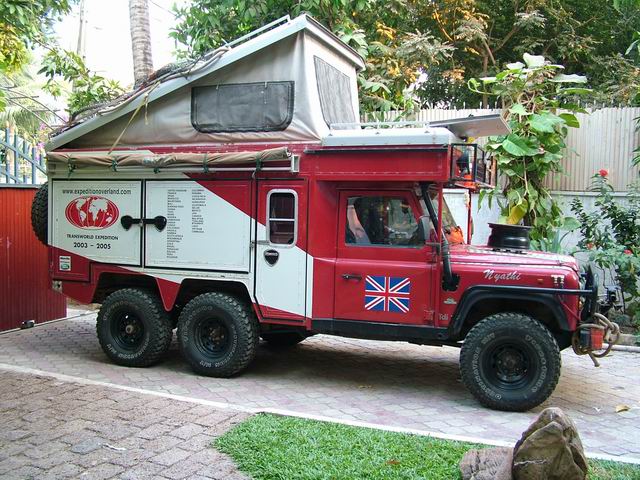
We both slept very well and this morning it stared raining, which was terrific fro bringing the temperature down. Over the last couple of weeks or so it has hovered in the late thirties and even broken the forties a couple of times. The other wonderful thing about the rain is that is stops that awful dust - hurrah! The border was about 10km away, so we got Nyathi ready for crossing (hiding any valuables, neatening stuff up a little etc. We met Koen (from Belgium) riding his bike. We slowed down and chatted for a short while and said we'd catch up at the border. We still had to fill up with water, as we only have one full 25 litre jerry can, but they let us do that at the pump at the customs station some 8km before the border. They never asked us about car papers and waved us on our merry way, so off we went (thinking formalities would happen later). When we got to the immigration check point, Koen was already there. The officials were relatively friendly, but wanted $2 each for stamping the passports. I was not impressed when we (quite correctly told them we had not had to pay on entry or exit to Laos before - except the one day when it was a weekend and that was $1 and they had signs up all over the place) and he accused me of lying, which I told him was rude and I took exception to it. After about half an hour of sitting and waiting they came down to $1, which Koen kindly paid for us. They would not stamp our carnet, so we told them not to worry and we left (we did not want to drive back 8km and start a new conversation up with the first customs post where we had already stopped to fill up with water). The Cambodian side was a lesson in how small border outposts should operate. For starters, they all spoke quite good English and they were friendly and efficient. They (very nicely) started off by asking for $3 each and we got them down to $2 and when we paid with a $50 they gave us lots of change in dollars, which came in handy, as we have run out of small notes and we could pay Koen back. They came to look at Nyathi, but said they were just Police and could not stamp the carnet, but they radioed to customs in Stung Treng, who gave the go ahead for us to have the formalities completed there later in the day. They also had the most delightful litter of charcoal coloured kittens who, along with the adult cats, wolfed down the cat kibbles I brought them. They also helped us with the pronounciation of our Khmer words and wished us good luck on our journey. What a great start to Cambodia! To celebrate we stopped a couple of kilometres down the road and had a brunch of peanut butter and jam baguette, washed down with cold drinks. Koen signed our guest book for us and we swapped details. I put Cambodia on the side of Nyathi - country number 42!
The surrounding forest, although no very dense, was filled with the sound of bird calls. The road as quite narrow but not as rough s we thought it might be.
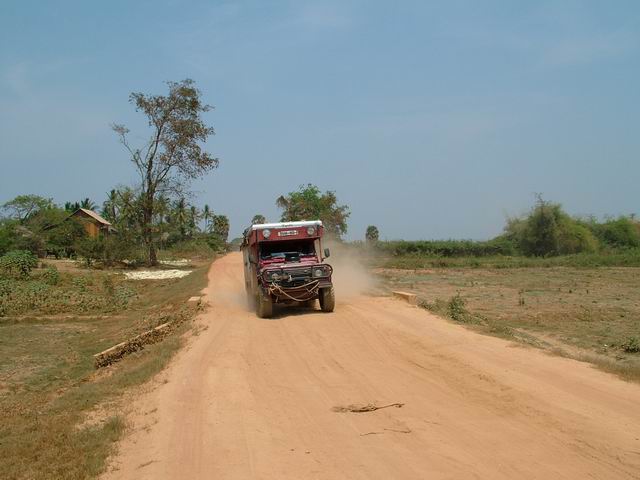
We were passed by one minibus, whose occupants waved at us. The Cambodians are another nation of super friendly people. They all smile and wave and most of them shout hello and or goodbye in English. In return we practise by shouting back in Khmer and English. The road was in very good condition as it has recently been improved and graded (and work still continues, which means there are a few very very dusty detours). On the whole we were impressed, especially as we expected a hellish road. We had to stop en route to help a taxi (the same one which passed us earlier) which had gone off the edge of the road a bit and sunk down into the very soft, muddy road edge. When we stopped, the driver gave us Michael's International Driver's Licence - how bizarre! He had apparently spotted it on the road in Laos, it must have fallen out when we got out the vehicle at the border. In order to minimise the muddiness we just used the winch rope to pull the minivan out of trouble, and the driver and all the passengers (including some farangs) thanked us and went on their merry way.
Our next challenge was crossing the river to Stung Treng. Gert and Miranda warned us the ferry man started at $15 with them and they negotiated down to $10. We saw the driver of the minivan we'd helped and he told us it was $15 for the whole ferry, divisible by the number of cars (max 4). We wandered down to watch the pedestrians catching longboats across (for $0.50 each) and we saw the ferry on the far (about 200m away) side, but without cars on it. A petrol truck was waiting at the top the hill when we first arrived, so we thought we'd just wait until he drove down and we'd follow. Unfortunately, hi mate in another petrol tanker arrived about an hour later and the two of them hooted to call the ferry over and drove down to the jetty (which is a one-way system). We followed hot on their heels and luckily, we just managed to squeeze on behind them, with our tail end on the ramp which is lowered up and down. The ferry man tried to charge us $15 and Michael just laughed and smiled saying no way. Then he went to $10, but in the end we managed to pay just $5, although he wasn't thrilled. The truck drivers tried to tell Michael they pay $20 - nice try! As soon as we drove up the ramp and into the town, touts approached us, but we told them we didn't need a hotel. Michael asked the police where customs were (and avoided all the questions of why? why?) and we headed down the road alongside the river, waited for all the cows to cross the one-way bridge and found the customs office 100m down on the left. We saw our first shot-up building en route, and I am sure we'll get to see more evidence of war throughout our travels. Anyway, the customs officer was extremely friendly and never asked for a thing. He gave us both a temporary import form (which Michael duly completed) and he stamped our carnet at our request. Full score for Cambodian officials so far. On the way out of town we stopped to buy baguettes and get a few dong (4,000 dong for $1).
It is actually quite amazing the variety of obstacles we encounter on the roads ranging from animals of all shapes and sizes and vehicles too, to houses indignantly ignoring the fact that a wider road is now passing through (see below) to people having picnics or celebrations, set up with picnic mats and chairs!
The tar section of road ended after about 5 km and the dusty road began. However, road construction continued (as on the other side) and the road was far better than we'd hoped for. The friendly smiles and waves continued and at about 17h00 we stopped for the night in a large (currently unused) quarry. One of the things we find so saddening (although it happens throughout the third world) is to see really young children battling with chores like fetching water, tending cattle and looking after younger siblings. I know it's simply the way of life, but sometimes we just want to reach out and help them. We also feel bad because we shower them with dust even though we drive slowly past and today we felt even worse because after we slowed down to pass (and take a photo of) a little boy and his bare bottomed brother, they fell off their big bike because they couldn't keep their balance.
The tar section of road ended after about 5 km and the dusty road began. However, road construction continued (as on he other side) and the road was far better than we'd hoped for. The friendly smiles and waves continued and at about 17h00 we stopped for the night in a large (currently unused) quarry. We had filling tuna baguettes for dinner and I wrote the journal for the last two days and then Michael tried to send emails again, but the satellite connection came and went and he had no success.
The morning was surprising cool, in the late twenties right up until 13h00. We took advantage of the slight breeze and fairly dust-free gravel to do some Nyathi maintenance. I use the term 'we' loosely. I was just the oil-pumper and tool-passer, while Michael did the majority of under carriage work (which was not too pleasant as it was caked in a layer of mud from the roads). He also checked the engine tappets and syringed in gear oil, which required Nyathi to be parked at rather a severe angle off the side of the quarry.
We really enjoyed our drive as the villages were very interesting and the people friendly and enthusiastic. We stopped in one village to buy a cold drink and so I could take a quick photo of some travelling pottery salesmen. Michael inadvertently switched the engine off and we couldn't get her started again. We had to resort to a spray of quick start, which did the trick.
We drove down to the Mekong and then turned north to go to Sambor, but could not find the ruins we expected. However, we did find an impressive temple and from a policeman's gesturing, they may have been what we came to see anyway.
What was much more enjoyable was the drive along the very narrow bumpy road lined with houses of all shapes and sizes and people congregating at the roadside to sit, work, eat and play.
Michael and I felt like an audio tape on repeat saying sua s'dei (hello) to everyone and waving out the window. Everyone was very happy and we got quite a few squeals of delight and excited jumping up and down from groups of children. In the end, we had to turn around as the road closed in so it could only accommodate carts and bikes. On the way back we changed our chorus to lyeea hai (goodbye). We stopped at one stage to give a little boy (whom we saw playing in the dirt with a badminton racket) a shuttlecock and his and his brother's eyes lit up. It was lovely to see.
We got to see many interesting activities including children helping their mother to crush grains using a levered log which three little ones stood on at the far end and then released to drop the wood and pound the grains in a mortar at the other end. In the meanwhile, she gathered them all together to get a good consistency. Other people were washing scooters using a pump with water from the Mekong, while others ran food stalls or mini beer halls. There was a lot of festivity in one of the villages and we saw a wedding couple along with all their guests dress in formal suits and dresses which were vibrant and colourful. We stopped and gave the bride and groom some of our heart shaped chocolates and took a photo of the (happy?) couple...
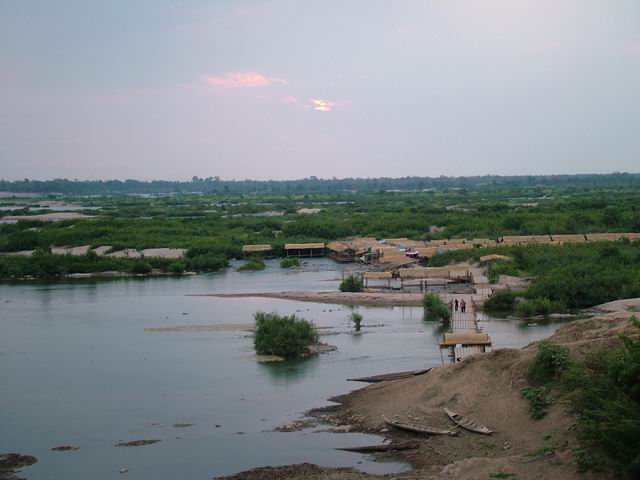
We continued south to a small village called Kumpie. As we drove over a bridge at the far end of the village we saw lots of what appeared to be a floating village down on the Mekong. Just past the bridge was a perfect clearing with a big shady tree for camping and it was opposite the police station, so we asked if we could sleep there. As usual, they said it was no problem and we parked under the tree facing the river below. Michael gave the policeman and a Joosrain (a translator) a cap from our give-aways nag, with which they were delighted. Joosrain's brother also got a cap and a young girl an old dress, as she happened to be there too. I told Michael we'd soon be swarmed by the whole village, but it stopped there. Joosrain asked if we could go swimming with him at the river. So we got our costumes on and I donned my skirt cum sarong and off we went. The floating village turned out to be rows of bamboo roofed platforms erected in between the river sandbanks where a few families live and provide restaurant / picnic facilities for visitors. Apparently the place heaves at New Year, which is why they have such a big cleared area (where we are camping) to provide parking.
The water was very pleasant, warm, relatively fast flowing and shallow, so it made bathing really easy. We had a dinner of rice, roast chicken (including the head, neck and feet) and salad, prepared (for over an hour) by Joosrain's aunt. At first we thought $3.50 sounded quite expensive, but if fed all three of us amply. We were attracted quite a lot of attraction and provided entertainment for a variety of local families! The setting was lovely. There was a cool breeze blowing and the river flowing underneath us, a lucky find!
We slept really well and were only woken up after 07h00 by inquisitive people talking outside. Michael had met someone yesterday who wanted to take us to see the Irawaddy fresh water dolphins, which we were quite keen on, but he never materialised again. Our morning was spent trying to sort out our battery problems. As Michael feared they are on their way out! I took the opportunity to read in the shade while Michael borrowed Joosrain's bicycle to ride into the village to try and find battery water. He had no luck and we knew we had some buried in one of the trunks , so we unpacked almost all of the side compartment, because it was in the trunk way at the back of the cavity. I did some glueing and a few odd jobs while Michael took our damaged tyre off the rim. We considered keeping it as an emergency spare, but the tear is pretty bad and given the reliable performance of the tyres so far, we would need to be very unlucky to have to resort to using it. We are sure the local village will put it to good use and it will do many more miles here in Cambodia, but we'd prefer not to risk it. Still we felt really bad about getting rid of it.
After a busy morning, we decided to go down to the river and relax in our hammocks. At the weekends quite a few families make use of the facilities and the locals charge 500 riel (13c) each to cross the bridges to get to the bamboo platforms and then 5,000 riel ($1.25) to use one platform for the day. We strung up our hammocks and at first, with all the people crowded in around us, it felt like it may not have been money well spent if a peaceful afternoon was what we were after. They picked up our books (both of which happen to have photos in them) and spent ages pouring over them. They are also happy to just sit and stare at you from 30cm away while you attempt to read. However, in the end, they pretty much left us in peace and kept plying us with cool drinks in our very own ice bucket and Joosrain's aunt brought us boiled duck eggs for lunch, which we wolfed down. We read our books, took dips in the river and just relaxed in the cool breeze, swaying gently in our hammocks (trying not to move too much as the bamboo platforms were just a little rickety). In the late afternoon Michael lost his sunglasses overboard and told the little girl nearby if she dived for them and found them he'd give her 10,000 riel ($2.50). He never thought she'd find them, as the current was quite strong where they'd fallen in, but sure enough a few minutes later she popped up with them in her hand. She was shivering (though I've no idea why, as we thought the water was positively warm), but she was so delighted with her 10,000 riel that she immediately ran off to tell her family of her new found fortune!
As the sun was setting, we watched the fishermen casting their net into the waters right next to us, but sadly the biggest fish they caught was about 20cm long. They work hard for their money, but they seem very happy and we saw them relaxing and eating their fare a little later.
We chose not to have dinner down at the water and explained to Joosrain that we like to try different things and spread our money through the village a bit, which he understood. Unfortunately despite walking a fair distance through the village, we couldn't find anything to eat which we would have liked. There was no rice, only dried fish and what we think were fish balls. Nevertheless, it was pleasant to walk through the darkened village (no electricity here) with a torch and to see the families gathered around the candlelight, or battery powered lights. I did a little diary, while Michael walked into town to see if he could get an earth connection for the battery. He found one, but frustratingly it was the wrong size. By the time he got back, I'd got into bed, so he did some GPS points and tried to send emails.
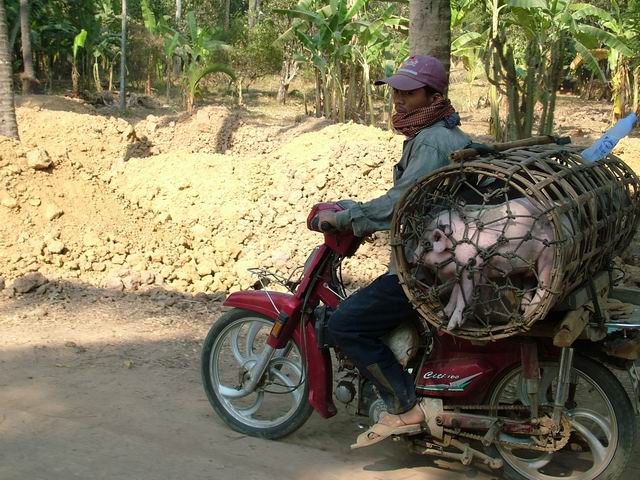
We packed up and said our goodbyes to the police and Joosrain. We discovered Kratie was about 15km south and we had a pleasant drive there. The road continued to be flanked by houses and lots of people coming and going. We saw lots of pigs in cylindrical wicker baskets being taken to market on the back of bicycles. We also encountered some of the tallest cattle we have seen pulling large, over laden wooden carts behind them.
We had a delicious breakfast of omelette followed by banana pancake (with maple syrup from Nyathi) at the Star restaurant. We were joined at our table by Robyn from Canada and Guiyanume and Barbara from France and we had a lovely time talking about travel and other stuff. Michael went to a large battery shop he had seen to enquire about prices while I went to the one and only open internet cafe to check emails for half an hour. The battery shop wasn't prepared to negotiate on price, so Michael decided to wait until we get to Phnom Penh where prices might be better, but annoyingly we ended up having to get a bit of help with a quick push from some of the locals to get her going a bit later. We decided to follow the river road down to Chloung, instead of the main route as it would be a bit more scenic.
It was lovely, with villages scattered along the river shore, but the road was pretty potholed and very dusty, which required a lot of concentration, so we didn't get to see quite as much of the surroundings as we might have liked. After Chloung, we headed east down a better graded sand road, as we had heard the remainder of the riverside road gets too narrow for cars and we didn't feel like having to turn around halfway.
As we were driving along we discovered we had no power from the inverter. We pulled off into a quarry a bit further along and investigated the reasons why. To cut a long story short we ended up having to swap our expensive Synergex inverter (which we have already had to have repaired once) with the smaller Coleman one we had bought when the Synergex one failed previously. All in all, with having to check everything, take the fridge in and out etc. it took us about 1.5 hours. I got stung by something which crawled up my trousers and I think Michael had to contain laughter as I screamed for him to come and help while holding onto my trousers (where I thought I'd caught the culprit) and dancing around like a mad thing. I whipped my trousers off as quickly as possible, but no stinging crawly was to be seen, still, at least I had a swelling sting mark as evidence! Once we headed west the road was tarred and in pretty good condition thanks to Japanese funding there was also and impressive bridge over the Mekong River too! The amount of traffic increased but the variety was still the same. It is quite amazing to see how hard they make their bicycles, motorbikes, cars, trucks, horses and oxen work here. My maximum number of people I've seen on a motorbike so far is five (four adults, one child), but I wasn't quick enough to get a photo.
We stopped in Kampong Cham (hometown of Prime Minister Hun Sen) and bought two 90 Ahr maintenance free batteries for $57 each. As we drove along and the endless stream of houses continued we knew that a night in the wilderness was out of the question. Instead we passed two monks coming out of a temple who looked very friendly and when we stopped they came over and spoke to us and through charades we asked if we could stay inside the temple compound, which they said was fine. One was a very old man and clearly the most senior monk at the temple and the younger monk Tay, was the one who spoke a few words of English. We were an instant attraction and quite a few monks, novices and their friends gathered round (at a respectful distance) to watch us settle in. We took out the fridge and the knackered battery and put in the two new ones and then put the fridge back again. Michael offered them the old battery and they jumped at the offer. We regretted it just a few moments later, when we heard music blaring, distorted out of an old ghetto blaster and saw our old battery as the trusty power source! They kindly offered for us to take water from their well to shower and after hauling up my first bucket I realised I'd have to do the lifting more quickly as the bucket was leaking. One of the local boys who spoke some English offered for us to use the bathroom at his family's house across the street, which we accepted. It was great because the bathroom was clean, completely private (which meant I could shed my bathing sarong) and lit with electricity. We used the water sparingly as we noticed it wasn't piped in, despite being stored in large, open bricked tanks built into the wall. we each took turns chatting to the family while the other bathed. Our conversation was limited, but pleasant and the old woman found it unfathomable that we did not have any children. She asked if I liked children and when I answered that I did, the nearest dirty child was unceremoniously dumped in y lap. In fairness, she was a lovely little girl who could count up to her 6 years of age in English and announce 'I am a girl', which was most endearing. We said our thanks a little later and left them to their family affairs. Michael tested and helped one of the monks fix his torch and we gave Tay two new batteries for his. then we retreated to the tent where we had baguette with peanut butter and jam followed by salted biscuits with sardines, which went down very well!
We were woken much later than we thought we would be at 06h00 with monks chattering outside the vehicle. Although we did not see them collecting alms we offered them a selection of foods from our kitchen of which the firm favourite was a jar Ovaltine! We tried to explain how to use it all (mixing water with the skimmed milk, concentrated cordial, custard powder, soya mince etc.) It was great to watch them a little later gathered around the table on the far side of Nyathi sampling and smelling everything. I also fed the hungry resident kittens and puppy Whiskas, which they ate ravenously.
We asked if we could take photos and they were all very enthusiastic. The eldest monk had his taken first, then Tay and so on and so forth. They were most appreciative of the food and battery and we waved them farewell with big smiles.
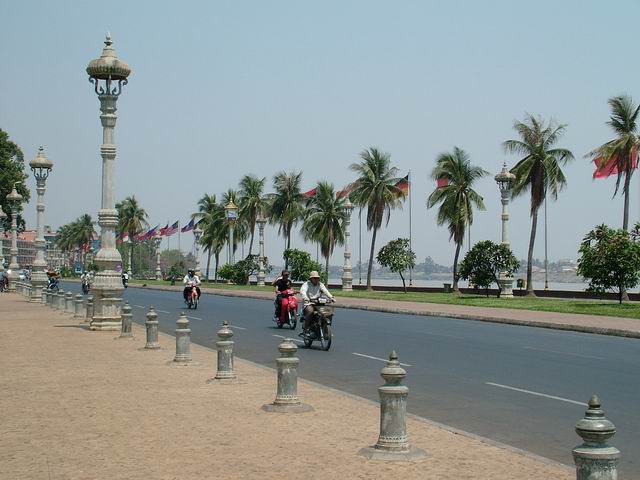
We made good time to Phnom Penh with just one wrong turn, which we rectified within 200 metres. The traffic was interesting to say the least. There are loads of motor bikes and bicycles all over the place, mixed up with human and animal driven carts and cars of all shapes and sizes. There is not set pattern to the traffic flow (some of it coming in the wrong direction towards you on with more crossing your path diagonally) but it seems to work. Michael has determined that the trick is to keep going slowly and not to make any sudden gestures and everybody seems to get around everyone else! Navigating for me wasn't too bad as we have a good city map and most of the roads are sign posted (and in English) which makes it all much easier! We drove around in a large "rectangle" along the main streets of the city to get a feel for the place. We located the Cambodiana Hotel (where Gert and Miranda had parked their car when they were in Phnom Penh) and then we made our way down to the Tuol Sleng Museum. We phoned Caroline (whom we had met at the Thailand Elephant Conservation Centre on our mahout course) and she kindly offered for us to park Nyathi in drive at her house (which is currently being painted before she moves in). We agreed to meet her there at 17h30, which was great. We decided to get something to eat at the river front and drove past her house en route so we'd know where to go later. We had a lovely lunch At Sa'em Restaurant and we bought an awful Khmer / English dictionary from one of the wandering salesmen. There were about half a dozen beggars (two of whom were disabled - but not landmine victims) along the touristy part of the city which was fewer than we had anticipated. We drove back down to the Tuol Sleng Genocide Museum, formerly known as S-21 for Security Office 21. It was the premier security institution during the Khmer Rouge regime, with "branches" in other locations around the country. We paid $2 each to get in (and didn't get a receipt, so I'm not sure exactly how much of the fee goes toward funding the museum). They claim they have about 50 visitors per day, but there were at least 100 people in the time we spent there. Tuol Sleng was originally a school, but when the Khmer Rouge took over the city on 17th April 1975 they turned it into a detention and interrogation centre. The school walls were reinforced with corrugated iron and barbed wire and all the classroom windows covered with iron bars. The people incarcerated in the prison came from all over the country and from various walks of life. There were a few foreigners too, but the vast majority were Cambodians. Every prisoner was "numbered" and photographed and many of the classrooms are filled with thousands of photographs of the victims. It is incredibly sobering to walk from room to room seeing the faces of all the men, women and children who died at the hands of the Khmer Rouge. There was a distinct air of sadness and disbelief as visitors stared at row upon row of pictures.
Apparently of the almost 20,000 inmates only seven survived as they were artists and their job, among other things, was to sculpt statues and busts of Pol Pot. The majority of people were sent to their deaths at the Killing Fields at Choeung Ek, while the victims of torture were buried in mass graves within the S-21 compound. The heinous acts that went on both within the confines of S-21,and outside are too awful to contemplate. Within the grounds of the museum are 14 graves of the last victims of torture who were found manacled to the beds with the Khmer Rouge were ousted in 1979.
Originally torture and interrogation took place in the houses surrounding the compound, but the men and their methods were hard to control and many women were raped, so rows of old classrooms were used as interrogation and torture rooms instead. Currently, each room features a photograph of the tortured victim as they were found in 1979, along with the bed and torture tools used. It was appalling too see how battered the bodies were and it gave a gut wrenching insight into how barbaric people can be.
Depending on the importance of a prisoner, they were generally kept at S-21 between two to six months. The majority of prisoners were kept in mass cells where they had one or both feet shackled to an iron bar clamped to the ground. They were stripped to their underwear and slept in rows on the bare floor and were beaten for the simplest acts such as shifting position or not requesting permission to urinate or defecate in the communal box stored at the prisoners' heads. They were inspected four times a day and remained shackled throughout, unless taken to questioning, or worse... Here, Michael is looking at the shackle system and floor bolts.
Other prisoners were subject to solitary confinement. Classrooms were divided into small (2m x 0.8m) rudimentary cells which were constructed using bricks or wood. The prisoners were also shackled to the floor.
The museum shows a film describing events during the Pol Pot regime. It features a previous worker, who was responsible for driving victims out to the Killing Fields and one of the few surviving prisoners, who was an artist and he has spent a lot of time painting pictures of what took place while he was imprisoned at S-21. His evidence comes from other inmates, the glimpses of daily activity and various forms of torture being inflicted, along with what he was able hear from the torture rooms. Apparently one of the more gruesome practices was indiscriminate killing of babies by throwing them up into the air as targets for shooting, tearing them limb from limb or smashing them against trees as depicted in this painting...
The atrocities committed by the Khmer Rouge were brutal and merciless and visiting the museum really brought it home. There is so much more to the story and reading a book of memoirs from survivors compiled by Dith Pran in 'Children of Cambodia's Killing Fields' reinforces how terrifying it was for everyone and particularly children who were often torn away from their families, subject to forced labour, rape, starvation and death. What is still more incredulous is that the perpetrators are unpunished and free!
Feeling incredulous at how depraved and inhumane man can be, we went back to Nyathi (who had been baking in the sun outside the museum) and had a cool drink. We drove down to look for the Land Rover garage which the UK Embassy uses. We found it easily enough and arranged to bring the vehicle back on Wednesday to have the timing belt replaced and perhaps a few other things too. We met Caroline at her house and she showed us which bathroom to use and we caught up for a while. Then we dropped her back at her sister's house and we walked into town. It was quite a long way, but stopped and had had a drink en route and then we watched the in-line skaters at the funfair. Phnom Penh really comes alive at night with outdoor concerts, people having picnics all over the place (including on the pavement next to a main road), while others opt for the hammock restaurants (of which there are loads), which we thought would make for a tricky dining experience. We went for dinner along the riverside. Following our large lunch, neither of us were particularly hungry so we opted for salads.
Unfortunately the neighbours (many) dogs were rather noisy during the night, so we didn't sleep too well. Caroline's painters came to work fairly early, but I was so tired I put in some ear plugs and managed to go back to sleep. Michael went for a very long walk around town and only came back after midday. I spent the morning chatting to the security guards (Pichenda and Da Van, as well as the nanny, Bo Pha and Ali, the housekeeper). I polished up my very basic Khmer skills and ate some watermelon and a spoonful of rice and sauce with them for lunch. When Michael came back we drove to the river for a quick bite to eat and then made our way south for the village of Choeung Ek which is where the Killing Fields are located. We paid $2 each (again, no receipt) and once we shifted the initial group of child beggars wandered around in peace. Our first stop was an information stand with some photos of the victims, the thousands of skeletons exhumed and a long text which struggles, understandably, to explain the actions of the Khmer Rouge. The site, at first glance looks like bomb craters and many of the mass grave sites have signs describing the tangles of corpses found inside including "those without heads" and "women and children most of whom were naked". The victims from S-21 were brought here to be killed.
What we found chilling is that when we looked a little more closely at the ground underfoot we realised the rags lying scattered on the ground are the remains of victims' clothing and jutting out from the earth are their bones. Then we looked around and saw that there was similar telling evidence all over the site. It felt disquieting walking along the paths over humans' remains.
We were talking about how terrifying it must have been for the people from S-21 to be shoved in the back of a truck, bumped and jostled for 15km out to Cheoung Ek, knowing that these were their final hours. We saw one of the trees which was depicted in the artist's painting in the museum which we saw yesterday. It was put to use in executions, its purpose clearly marked on a sign...
A tall glass sided temple has been erected at the site as a memorial to all those who tragically lost their lives at the Killing Fields. A huge glass case at the heart of the temple houses the exhumed skulls of almost 9,000 of the victims who were buried in over 120 mass graves in the area.
Thousands of mass graves have been discovered across Cambodia and approximately 1.7 million people were killed during the 44 month Khmer Rouge rule. That represents almost a quarter of the population. When you look at all the skulls lying randomly on top of one another in the glass case it is hard to comprehend that each one represents a living, breathing human being, who, in the vast majority of cases was not guilty of any crime. People were persecuted for simply appearing educated or for not following orders down to the precise measure exacted by the Khmer Rouge. The skulls in the towering glass case are from men, women and children who were most often blindfolded, told to kneel in front of the mass graves and were summarily executed and their bodies either fell, or were pushed or kicked into the huge pit.
The favoured method of execution was to strike people on the back of the neck or head with blunt or sharp objects. It was said that this saved ammunition. The various forms of execution defy belief and for those who slaved in the fields or built dams etc. their death was often slow and painful. The death blows inflicted are clearly visible on these two skulls...
At 18h30 we went with Caroline for dinner at the Khmer Kitchen just a few blocks down on 57 Street. The service was very slow, but we just sat and chatted and enjoyed the surroundings. It was interesting to hear about the challenges of working for an NGO. The food was quite tasty and all in all we had a lovely evening. We bought the Killing Fields DVD from the gift shop at Choeung Ek and when we got back to the house after dinner we set up the screen and along with Pichenda and Da Van watched the movie in our outdoor theatre. The biggest drawback being the damn mosquitoes! It was particularly interesting to watch the film following the past two days. I had forgotten how good it was, even though it focuses mainly on one man's ordeal. In fact the movie was relatively tame in its portrayal of the horrors experienced by many during the Khmer Rouge occupation.
Michael took Nyathi to the garage first thing in the morning. He stayed at the garage and kept a watchful eye over the mechanics. They replaced the timing belt by lunchtime and in the afternoon he got them to take out the front differential o he could have a look at it and see if there were any problems which may be causing the droning noise we can hear, but it looked fine.
I took our very dusty and dirty clothing and bed linen to the laundry. Pichenda gave me a lift on the back of his motorbike. Then a little later he offered to take me to the Russian market, which is the largest market in Phnom Penh and sells just about everything. He was keen to walk around with me, although after two hours I think he may have been regretting his decision! We stopped mid way through to have a cold drink. It was great to have him with me as he helped with negotiations and translation. Although when we got back to the house Bo Pha chided him for letting me buy some tops for $1, which she says I should have got for 50c. Still, I felt like I got a good deal. I also bought a dress and some other clothes for Melissa and some CDs. I had a little bit of lunch with Pichenda and Da Van and then I went to the internet cafe for an hour. As Michael was still gone I went down to the garage to see how things were progressing. I helped out a bit there and by 16h30 we were ready to go. Michael has decided to take Nyathi back tomorrow for a few other things to be done as the labour is cheap and the work pretty simple. We stopped off at the laundry on the way home and collected all our clean and ironed washing! I tried to get her own on price by saying she didn't have to iron, but she said it was included in the price, so for the next few weeks our clothes will look a little more respectable. In the evening we caught a motorbike down to the riverside and had a delicious dinner of potato salad and gaeng kia wan.
We both slept well and the workers seemed especially quiet when they came in this morning. We could have slept in a little, but there were things to do.
We both went down to the garage this morning, stopping at the laundry en route as they had forgotten to give me back my favourite pair of jeans. Of course she was convinced she had and eventually I convinced her to open one of the packets in the pile for other customers and sure enough my jeans were there! Michael got the mechanics working on clutch and then we went to the Russian market. We split up for an hour and spent time wandering about on own, which was better, because although I find motor spares interesting, they aren't that compelling and Michael feels the exact same way about jewellery, clothing and to some extent souvenirs. I bought a small hand bag, some chopstick sets and a silver bracelet to go with the set I bought in Bangkok. When we met up, we had a cold drink and then we bought some lovely serving trays in wicker baskets. We really like Phnom Penh and we haven't done it justice yet! It is not too big to be overwhelming, but its still a lively busy place. The buildings vary from beautiful and well preserved, to others in the poorer areas which are in dire need of repair. However, in general the city is remarkably clean and we don't fell threatened when walking around, although we have been warned that bag snatching and hijacking does happen.
We went for lunch at our favourite riverside restaurant and in the afternoon I did lots of work on the website getting the photos ready to copy them into the text. Michael had a sleep and read his book for a while. We saw Caroline for a short while in the early evening and she invited us to join her at an artists evening, but I thought I had better finish the website so we can upload it. By 21h00 I had done enough (according to Michael) and we set up our outdoor theatre again so Pichenda could watch a movie with us. Unfortunately, the movie was appalling (Red Surf) and starred George Clooney in his younger, not so refined days!
We had every trunk out of the vehicle today in search of the ARB air locker fittings, which Michael eventually found in the diff box (which he had checked earlier but was convinced they wouldn't be buried at the bottom, which they were). I helped Bo Pha and Pichenda for a short while to move some of Caroline's furniture because her beds are being delivered today! We saw Caroline around lunchtime and she said it was fine for us to stay as long as we liked, but we plan to leave for Siem Reap tomorrow. She is off to Bangkok tonight for the weekend, but hopefully we will see her in Bangkok when she flies out again next week. Beth and Reid (whom we also met at the TECC) have invited us to stay in their compound, so we are really looking forward to seeing them again! I finished the journal entries and photographs, so that was a relief. I read a bit of my book and then we went to the riverside for an early dinner. We could have had some deep fried chicks and the lady who was cooking them kindly let me take a photo, but they didn't look very appetising to us.
Instead we went to our favourite haunt - Sa'em. Then we wandered up to Wat Pnhom and had a look around, but then we made our way back to the riverside to go to an internet cafe so Michael could upload the website. As we were walking past some cafes we heard someone calling us, it was Koen. We missed each other on the road when we headed north to Sambor. He has been very ill and didn't have the energy to lift his bike onto the boat to come down river - poor guy! We'll probably catch up again in Siem Reap. I also bumped into Robyn and it's likely we'll see her in Siem Reap too.
Michael had gone ahead to the internet cafe and then when I arrived he wasn't there. I thought perhaps he'd gone to a different one and spent a good hour looking, but to no avail, so I caught a motorbike back home. About 1.5 hours later he got home. He had to work at the back of the internet cafe and even though I asked the people if Michael was there, they didn't tell me there was someone in the back room! Nevertheless, I guessed Michael would know I came home if I didn't meet him, so it was fine.
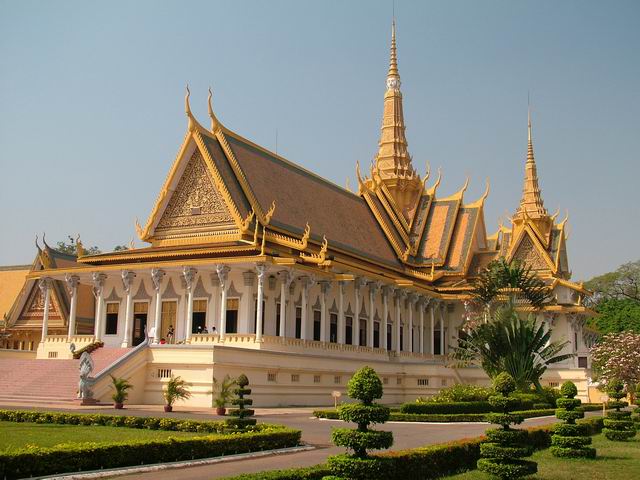
Today was lovely, but once again, incredibly hot. Michael spent the entire morning trying to upload the website, but frustratingly, did not succeed. I, on the other hand, spent a wonderful morning wandering about at the Royal Palace. It was remarkably peaceful and the gardens were immaculately maintained. The majority of buildings are in a good state of repair, but some are in dire need of some loving attention. The two most impressive buildings are the throne hall which was built in 1917 in Khmer style. The interior had colourful and very detailed murals of the Ramayana painted on the ceilings and the hall was sumptuously dressed with carpets, mirrors and gold coloured thrones fit for a king.
The Silver Pagoda was also very extravagant. It was originally built of wood in 1892 and rebuilt in 1962 by Sinahouk. The interior floor comprises more than 5,000 silver blocks which weigh nearly 6 tons, but sadly, they re covered for protection by carpet, so are not visible. In the centre of the pagoda is the 17th century emerald Buddha, made of Baccarat crystal. The temple has opulent displays of statues, images, trinkets and various precious metals, including a gold Buddha weighing 90kg and encrusted with over 2,5000 diamonds. As the writer Norman Lewis (1957) aptly describes it, "One imagined the Queen, or perhaps a succession of queens, making a a periodic clear out of their cupboards and then tripping down to the Silver Pagoda with all the attractive useless things that had to be found a home somewhere".
The grounds were filled with smaller temples, some of which acted as mini museums. The one had the daily costumes which are worn in the Royal Palace each day. Essentially the women wear different coloured silk skirts dependent on what day of the week it is. There was also the Napoleon III Pavilion which was originally presented to Eugenie for her accommodation during the Suez Canal openings and thereafter it was packed up and sent to the King as a gift. Another interesting relic, is the statue of King Norodorm on horseback, which was originally a statue of Napoleon on his steed, with the head lobbed off and replaced by the monarch's.
Michael and I got together for lunch and he drowned his unsuccessful uploading session with a few glasses of ice cold beer. Then we headed off to the market where we bought 65 DVDs for just $1.50 each, along with music CDs for Ashley, clothing for nieces and friends. Trousers for Michael and a few other things too. We spent the entire afternoon there and it was swelteringly hot. A few innovative street urchins and begging mothers would stand and fan you with a piece of cardboards for a few minutes in the hope of a tip! We caught a tuk-tuk, loaded down with all our purchases. Back at the house Da Van he had given Nyathi a quick wash and then he cleaned our bikes for us too. We gave him some money which he did not want to accept, but we insisted. I went to a street food stall and bought us all some rice and curried beans and chicken for dinner for the princely sum of 3,000 riel (75c) and it was very tasty! Pichenda arrived shortly afterwards and shared it with us too. We also tried a chilli mango paste which Da Van's wife had made - it was delicious. We watched a DVD again in our outdoor theatre and at 22h30 fell into bed after a nice cool shower.
We got up at 07h00 and did a few remaining jobs around Nyathi. Then we had cooling showers and we said our farewells to Somol, and left a little dress as a present for Pichenda's new baby girl, Rebecca. We stopped at the market and I bought Michael another pair of 'Columbia" capri trousers and two pairs for me, all for just $10.50! I bought some hot baguettes in anticipation of the cheese and jam ( and even ham) that we could buy at Lucky supermarket on our way out of town. We drove north out of twn past Wat Phnom and retraced our steps for about 70km before heading toward Kampong Thum. En route stopped to watch some men washing their ponies in the dam. There are quite a few ponies here which pull carts. They all have colourful headdress and bells that tinkle tunefully as they trot along. We also got to see live ducks strapped by their feet to the back of a pick-up, dangling head down. We thought they were dead until a few of them lifted their heads and started quacking! The vehicle was also piled high with all sorts of goods and on the top - people! The road was very good so we made good time. We had to stop and sort out a battery connection problem as the fridge wasn't working. It was a bit irritating, especially as once we'd put the fridge and everything back, it stopped working again, so we had to take it all out again, but after that, Michael had it sorted! Annoyingly we missed the turn off to Sambror Prei Kuk which is a pre-Angkor kingdom, but turning back would have meant an almost 200km detour, so we decided against it. Instead we drove south off Route 6 toward the lake of Tonle Sap, where the Rolous group of temples are en route. Once again, we couldn't find them (perhaps they don't put signs up to ensure you use a guide). Nevertheless, we continued down the narrow tar road through small villages who all seemed very happy to see us. Soon the road deteriorated into a dust powder trap filled with huge dongas and rickety bridge diversions. It was so narrow at times the cyclist and motorbike drivers we passed had to stand right in amongst the bushes.
Tonle Sap lake is south of Siem Reap and is the largest body of fresh water in SE Asia. In the dry season the Tonle Sap River (which is 100km long) continues its natural southerly flow into the Mekong. However, in the wet season things are dramatically different. The force and quantity of the water flowing in the Mekong causes the Tonle Sap River to reverse its flow and as a result the Tonle Sap lake floods the surrounding plains increasing in area tenfold (300,000ha to 1.5 million ha) and up to a height of 12m. The residents in the area have three different rice harvests as they make use of the receding waterline after the rainy season. I found it quite fascinating that the extraordinary changes in water level have lead to the evolution of a "walking catfish" which can survive for hours out of water while they flop about searching for a new, deeper pool to swim in. After about 10km of bone-jarring driving we arrived at the village of Kampong Phlong. The houses were built on stilts standing about 6m above the ground. At first we though the village was deserted, by as we drove further down things came to life a little.
The village is on a river leading into the lake and we wandered down to watch the activities on the water. They were digging silt out of the river and some of the villagers were on their longboats ready to go down to the lake. There were also three cages in the water with crocodiles basking on floating platforms.
Some of the little boys wanted to hold our hands and in fact one was very insistent and then didn't want to let go - I had to wrench my hand away. His hands were absolutely filthy and left my hand looking decidedly grubby. I made a conscious effort to keep it far away from my face, mouth and camera! When we got back to Nyathi the kid were all waiting for us and shouting hello and goodbye. They wanted me to take photos of them and thought it was terrific that they could all see the image afterwards. The shrieks of excitement were piercing and they all pushed one another out of the way to see until I got them to come by one by one and then they were all happy.
Then we gave away our remaining "gift" clothing to a very appreciative group of villagers. I called one of the adult women over and gestured to her and the older men that the clothing should be shared among the people. One old guy was clearly thrilled with his new Polo shirt and was keen to pose for us. Then we jumped in Nyathi and droves slowly through the village with everyone shouting goodbye and waving. We washed our hands with disinfectant soap as soon as we were clear of the village.
About 5km along the road we found a level spot in a riverbed to camp. It was right next to the dusty road, but we were partially obscured by bushes. We had refreshing washes and got rid of the dust of the day. We shared a baguette with ham and cheese for dinner, which was delicious but didn't quite satisfy us. However, we didn't feel like it was worth the effort to cook, so we left it at that! We saw a single cloud on the horizon behind us rumbling with thunder and crackling with pink lightning. It looked fantastic against the night sky and we decided that if the rain started we'd had an easy exit from the riverbed, so we could drive out if we needed to, but as we thought, the rain never came.
We had a pleasant drive out through the villages to the main road. It was market day in Roulous and the place was a hive of activity with loads of colourful fruit and vegetables on sale, along with chickens (alive and dead), fish, noodles, rice, motorbike spare parts etc. They obviously don't have vehicles driving through very often because they had to move some of the merchandise to the side so we could squeeze through. There were lots of people coming and going on various modes of transport, making driving a little hair-raising. As always we were greeted by the waves and smiles of the children as we drove by...
At Siem Reap we stopped to put a bit of diesel in and we found the locals very intrusive there. They even had the cheek to open the side compartment and Michael had to ask them what they thought they were doing. Then the baguette seller tried to sell me bread for 1,000 riel each, when it should be 500 maximum, so I told her I didn't like being ripped off and left. Thankfully, not everyone was the same. Just around the corner another seller offered me the baguettes at the correct price first time, so I bought five for us and we headed to the main office to buy our 3-day passes for Angkor Wat and all the surrounding temples. The passes are $40 each, which we felt was expensive, but there is no opportunity to bargain and the frustrating thing is that it is controlled by a privately owned company and we understand that less than half the entrance fee goes toward the temple upkeep etc. I made us some lunch and then we drove around getting a feel for the place. Thankfully we were able to drive Nyathi around the area without any problems and she fitted through the fairly narrow walled entrances (we watched a small tourist bus squeeze through first and then we followed) to the Angkor Thom complex.
Angkor Thom is the ancient walled capital of Jayavarman VII. The city was surrounded by a 100m wide moat (apparently filled with crocodiles) and it extended for 12km. The protective stone walls stood 8m high and there were four imposing gateways leading in and out of the city. Each gateway was wide enough to accommodate an elephant with rider, topped with processional parasols. The gateway surrounds were intricately carved and crowned with four giant heads each facing north, south, east and west. The impressive causeways leading over the moat and up to the gates were lined with powerful carvings of gods and demons fighting down a large naga (snake). Our first stop was the Bayon. After Angkor Wat, it is considered the ruins to visit. The Bayon sits at the centre of Angkor Thom and is a magnificent place. The central tower stands 45m high and bears four slightly evil looking heads facing the four cardinal points. There are a further 51 towers within the temple, each with four heads.
The bas-reliefs tell stories of the kingdom's history, as well as legendary tales. They are very detailed and it must have taken them ages to whittle away the stone.
There is some evidence around the outside of the temple of how invasive the trees can be and there are quite a few large trunks chopped down to their bases which protrude through the stone work.
We bought some drinks from a local vendor and I paid 500 riel to use the 'park' toilet facilities, which, I have to say were spotless. We were feeling a little sleepy and the heat was quite intense so we decided to look for a quiet shady spot to have a quick forty winks. At first we were just going to sleep in our seats, but then decided we'd probably get more peace if we put the tent up and slept there. We took the fans from the cab into the tent to provide extra cooling power, which was very much needed! We bumped into Robyn again while she was travelling on a tuk tuk in te opposite direction, so we chatted for a while. Then we visited Preah Khan. It was Jayavarman VII's first capital, before Angkor Thomwas completed. There was a small exhibition near the north entrance explaining the restoration work being carried out, which was interesting to read.
The ruins themselves were labyrinth-like and had excellent displays of carving both on the interior and exterior. There were a number of rooms and vaults which were out of bounds because the huge brick walls had collapsed in on each other. It was incredible to witness the power of nature as the tree trunks grew at their will and caused severe damage to a lot of the ruins.
Our timing was perfect as just before sunset the light gave a warm glow to the place. Better yet, the place was deserted and so peaceful. The amount of birdlife was quite something and we counted at least ten different calls. It was the perfect end to a very pleasant day. As we drove back to Siem Reap we passed by Phnom Bakheng, which is the popular sunset viewing spot. We were so glad we hadn't chosen to o there as there were at least a thousand people pouring back down the mountain and the roadside was lined with loads of buses, taxis, tuk-tuks and motorbikes. We found the guest house where Gert and Miranda had parked and we had cool showers followed by a delicious dinner coked at the guesthouse. We wandered down into town for a while and we have decided (although it was pleasant enough) we definitely prefer Phnom Penh. Back at the guest house we met (separately) Philippe from Canada and Tim from the USA, who provided great conversation and we chatted until almost 02h00!
After a good night's sleep and a breakfast of what were meant to be pancakes, but turned out to be very heavy cake-like things of which we only managed to eat one! We drove through Angkor Thom and around to some of the lesser visited temples. The first of which was Ta Keo.
The temple was never completed, although it was started during Jayavarman V's reign. Although the guide book said it was missable in favour of some other ruins, we found it quite imposing.
Michael particularly liked it for its entertainment possibilities which included jumping, boys will be boys...
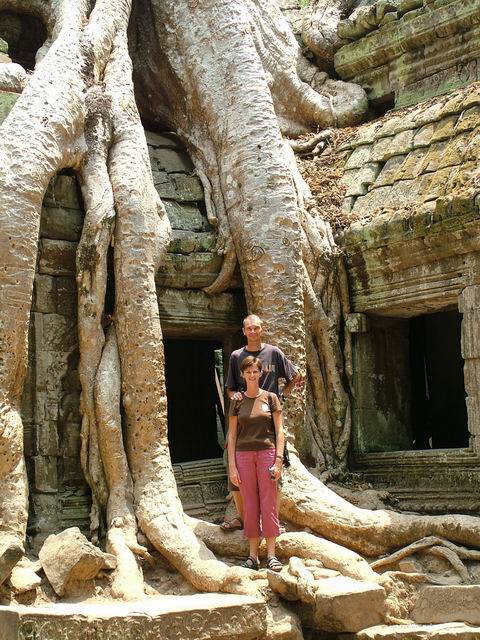
Our next stop was Ta Phrom, whcih is renowned for having a more overgrown, jungle-like atmosphere. You have to walk along a wide path through the forest to get there and the strains of Khmer music ring through the air from a small band of entertainers along the way. There were a number of great examples of tree versus building scenarios.
Ta Phrom was consecrated in 1186 and was a monastery which, in its heyday, housed 18 abbots and almost 3,000 monks. It comprised 39 prasats (sanctuaries) and more than 800 stone or brick dwellings. We found the invasive trees quite incredible. It was like a gargantuan octopus was trying to smother the place with its tentacles. Having said that, we still think Preah Khan wins the contest for a temple with more charm and surrounding leafy forest.
While driving to Pre Rup ruins, we saw loads of local people standing waist deep in the baray methodically pulling up all the reeds. We're not sure what they use the plants for, but they were collecting them in vast quantities and it appeared to be done on a co-operative basis. Pre Rup was built in 961 of laterite, with brick prasats. It is quite eroded and very few of the original carvings remain. We found it interesting for it's warm red colouring and the fact that it is a number of centuries older than most of the other temples.
We took a slightly circuitous walking route through Ta Som and at te far end we discovered yet another tree strangled building. There were many notable carvings and in some instances where the bricks and pieces have fallen down they have reconstructed the structure on the ground. The time for our afternoon nap was long past so we found a quiet spot in a disused field behind some trees where we parked up and had a welcome nap.
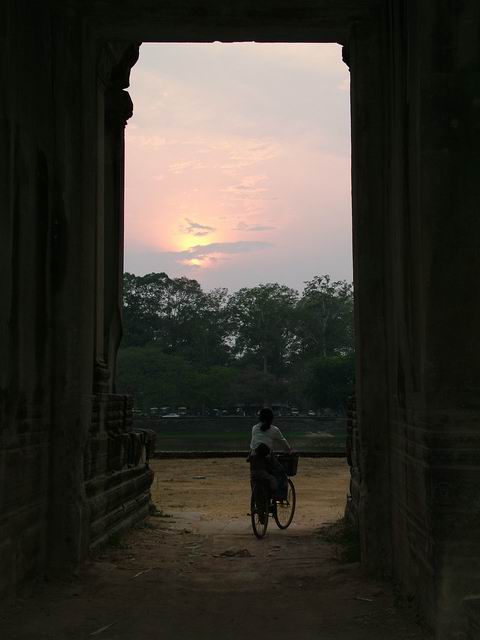
We opted to spend sunset at Angkor Wat. Because of all the air pollution the sunset was far from spectacular. It disappears behind a haze way before it reaches the horizon. Still, the ambience was lovely despite the vast numbers of people leaving the main building and walking along the paved boulevard to the outer ramparts. We stayed until the very end, when we were ushered out by a patient security guard, the last people to leave.
Back at the guest house we had a relaxing evening.
We were up at 04h45 to catch the sunrise at Angkor Wat. We got there by 05h30, parked Nyathi and wandered up the deserted causeway, lined with balustrades of nagas (snakes). At first we thought our enthusiasm had got the better of us as it was still pretty dark when we got to the main temple. However, it afforded us the opportunity to get the best photography spot from the cruciform platform before anyone else arrived. Sadly, the dawn sky was not as glorious as we had hoped, but it still made for a pretty picture...
Many tourists congregate around the pond some distance in front of the temple to catch the reflection in the water. We wandered down and did that at about 06h20. The local vendors offer hot tea and coffee and were astounded when we didn't want any! How can we not have an early morning "cuppa"? Angkor was is a grand complex, but for us, it lacked something, which we can't quite identify, when thinking about some of the other ruins we have seen. Machu Pichu, for instance has its splendour heightened, quite literally.
What is magnificent about Angkor Wat is the overall size of the main temple and its superb bas relief which runs along the corridors of the outer gallery. The relief is 2m high and is believed to be the longest, continuous bas relief in the world. It depicts the colourful legends of battles and life past. The intricately detailed carvings show royalty mounted on hefty elephants, monsters pulling chariot and the famous churning of the sea by gods and demons to make ambrosia (considered the nectar of the gods which provides immortality).
Some of the images receive a lot more attention than others by visitors. This is clear from the well rubbed breasts of the apasaras. Apsaras are celestial temptresses whose sole purpose is to have eternal sex with Khmer heroes and holy men. The carvings cast them in alluring positions, showing off their elaborate clothing and head dresses.
We spent a good couple of hours climbing up and down all the stairs and investigating the different nooks and crannies within Angkor Wat. Then we drove down to Angkor Thom and stopped to watch the friendly monkeys along the way. They are very accustomed to humans, although the ones with young were understandably a little skittish.
We wandered through the area surrounding the Royal Enclosure within the Angkor Thom complex. Baphuon is being restored by the French and it looks like a mammoth undertaking. The temple has deteriorated considerably as a result of subsidence and neglect. Our next stop was Phimeanakas which was an imposing pyramid temple gurded by elephants and singhas (lions). We really out to have climbed to the top, but we simpy didn't have the energy nor inclination. What we found more interesting was the dramatic bas relief of elephants and their warriors at the Terrace of Elephants. Then we went for a breakfast of omelette and baguette at one of the copious food stalls near the car park. It was wonderful to sit and relax for a while and watch the world go by - children running in the dust covered car park, impervious to the dangers of reversing buses and bikes, heavy cumbersome loads of fresh green coconuts being delivered by bicycle, people dozing in hammocks strung up in between the mini restaurants...
Then we headed north east out to Banteay Srei which took us about 45 minutes. We drove through some attractive little villages which sold baskets and other wares. Banteay Srei was very distinctive and rather diminutive compared to some of the others. However, what it lacks in largesse it more than makes up for it in beauty and ornamentation. The pink sandstone buildings were constructed by a Brahmin priest and were not intended for royal use. You have to duck down low to enter through the small doors and gateways.
Almost all facets of the buildings are adorned with carvings. The work is immensely intricate and portrays gods and demons with tongues of flame and less out of this world ideas, such as delicate flowers in full bloom.
After driving back through the villages and around the ruins for a while we decided to go back to the guest house for an afternoon sleep. That was a mistake. We hadn't counted on so little shade and the heat was absolutely stifling. We both had to shower mid way through our sleep and we kept our face cloths in bowls of cool water to wipe ourselves down so we could cool off under the three fans! We lasted just over an hour and gave up. We spent the remainder of the afternoon reading boos and drinking cold water and juice while sitting directly underneath one of the large rotating fans at the guest house restaurant. Later in the evening I went for a serious massage by a blind women who had unbelievably strong hands. Still, it was enjoyable for the most part, but difficult to get the message across to her to lean a little lighter when my Thai is so poor and I can't use "charades". | |||||||||||||||||||||||||||||||||||||||||||||||||||||||||||||||||||||||||||||||||||||||||||||||||||||||||||||||||||||||||||||||||||||||||||||||||||||||||||||||||||||||||||||||||||||||||||||||||||||||||||||||||||||||||||||||||||||||||||||||||||||||||||||||||||||||||||||||||||||||||||||||||||||||